
Radial Load vs Axial Load in Bearings
Table of Contents
Understanding radial load vs axial load
Understanding radial load vs axial load is essential when selecting the right bearing for industrial machinery. Bearings are designed to support forces acting in different directions, and choosing the wrong type can lead to premature failure, vibration, or reduced service life.
What Is a Radial Load?
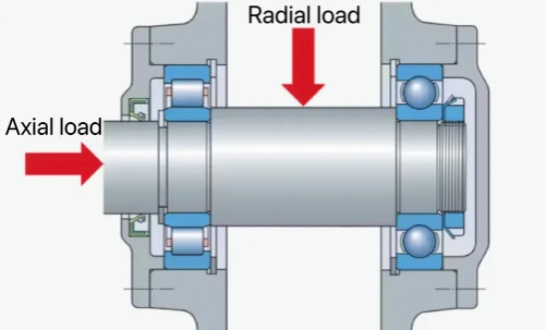
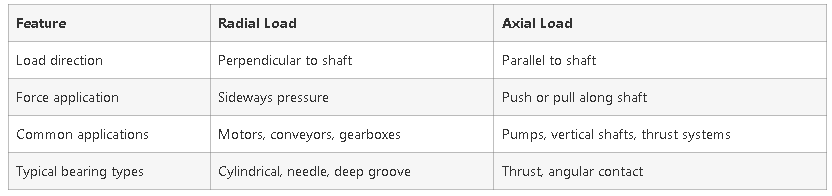
A radial load is a force applied perpendicular to the shaft axis. In simple terms, the load pushes against the bearing from the side.
Radial loads are the most common type of load in rotating equipment. They typically occur due to the weight of components, belt tension, or gear forces.
Common sources of radial load
- Electric motors
- Conveyor rollers
- Belt and pulley systems
- Gear transmissions
Bearings best suited for radial loads
- Deep groove ball bearings
- Cylindrical roller bearings
- Needle roller bearings
These bearings are designed with rolling elements that efficiently distribute side forces across the raceway.
What Is an Axial Load?
An axial load (also called thrust load) acts parallel to the shaft axis. This force pushes the shaft either forward or backward along its length.
Axial loads are common in applications where thrust or directional movement is involved.
Common sources of axial load
- Vertical shafts
- Thrust from helical or worm gears
- Pumps and compressors
- Propellers and screw mechanisms
Bearings best suited for axial loads
- Thrust ball bearings
- Thrust roller bearings
- Angular contact ball bearings (for combined loads)
These bearings are engineered to handle directional forces without excessive friction or deformation.
Radial Load vs Axial Load: Key Differences
Combined Radial and Axial Loads
Many real-world applications involve both radial and axial loads at the same time. In such cases, selecting a bearing that can handle combined loading is critical.
Bearings suitable for combined loads
Angular contact ball bearings
Tapered roller bearings
Spherical roller bearings
These designs allow the bearing to maintain stability while supporting multi-directional forces.
Why Load Direction Matters in Bearing Selection
Incorrectly estimating radial or axial loads can result in:
Excessive heat generation
Early bearing fatigue
Shaft misalignment
Unexpected downtime
Proper load analysis ensures:
Longer bearing lifespan
Improved machine efficiency
Reduced maintenance costs
Stable and quiet operation
Practical Tip for Customers
When choosing a bearing, always evaluate:
Direction of force (radial, axial, or both)
Load magnitude
Operating speed
Shaft alignment
Environmental conditions
Matching the bearing design to the actual load conditions is more important than simply selecting a bearing by size.
Conclusion
Radial load acts sideways on the bearing and is the most common load type
Axial load acts along the shaft and requires thrust-capable bearings
Many applications involve combined loads, requiring specialized bearing designs
A clear understanding of radial vs axial loads helps prevent failures and ensures reliable, long-term performance of rotating equipment.